
Showing posts with label prophetmuhammad. Show all posts

Saturday, January 23, 2010

Islamophile: Part 2

"All you young political pundit lovers out there, set your hearts to throb!"
--Jon Stewart


Screenshot2009-09-01at73435PM.png picture by monsterunderkilt
Fig.1 My favorite Iranian

Soon after the start of my religious awakening, Jon Stewart opened his show with that line. It is the most astute assessment of my cardiac activity whenever the mop-topped bespectacled religious scholar Reza Aslan appears on TV.

In religious scholar/Middle East expert commentator circles, Reza is “something of a Beatle” as Jon said, also joking that when people think religious scholar, “they think younger” than thirty-something Reza. I haven’t seen any other religious scholar hip enough as to appear on all the kids’ favorite news commentary shows and Facebook and MySpace and The Daily Beast and Bloggingheads and Twitter. Beatle comparison earned.

Once I was watching a documentary on the history of the Qur’an and the moment Reza unexpectedly popped up to offer his insight on the socio-political context in which the Medinians battled the Quraysh, I had tachycardia. I have since collected some of his greatest lecture hall hits on my iPod. You know, for those cold, dark, lonely nights studying the Qur’an. Reza can give me theological exegesis any day.
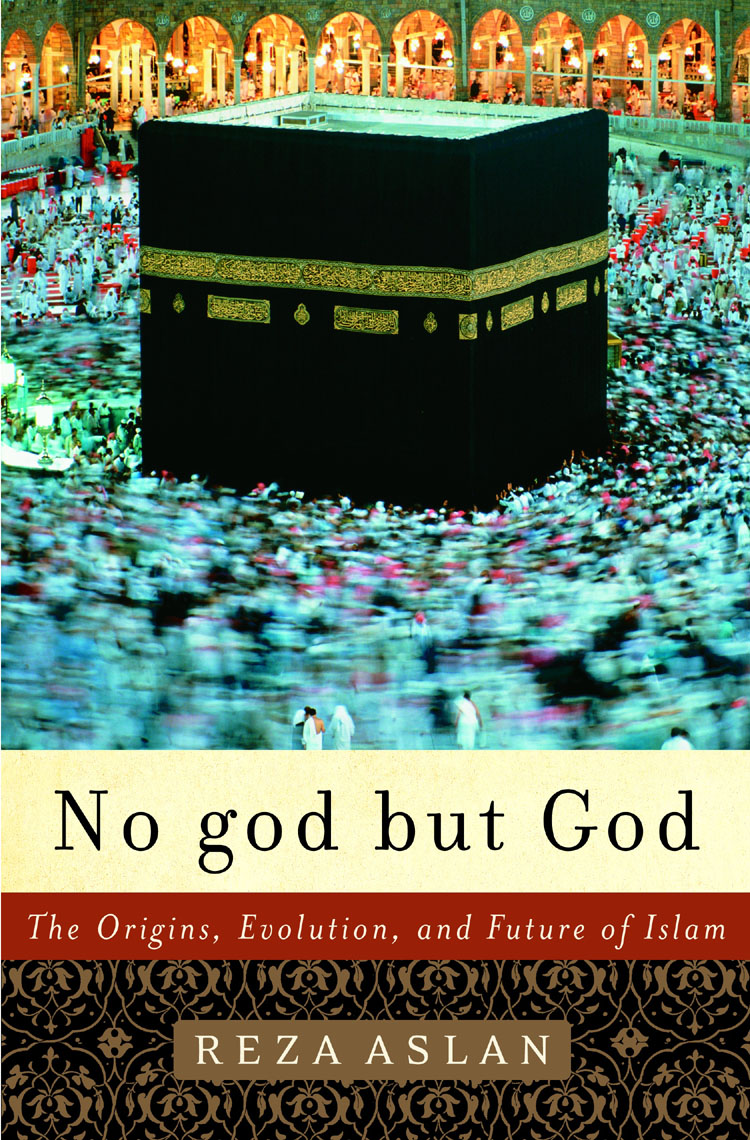

Fig.2 A revelation unto pop culture

Anyway, Reza sat across from Jon that day and I fell for him the moment he displayed a sense of humor about his religion. The book he was promoting, No god but God, is the first I ever read about Islam. No god but God has since been translated into a dozen languages and is frequently hailed as a great introduction to the faith. It came just in time, too.

Through Reza’s stories of fleeing Iran when he was just a boy and his vivid descriptions of what the Prophet Muhammad experienced during the infancy of Islamic history, the most misunderstood religion in my society was revealed to me with actual truth and deep understanding. What little fear I might have had regarding Muslims was forgotten. Finally, for my part, the Prophet had a face not colored by Arabian stereotypes or tainted by propaganda. It was a face not so different from Moses: the reluctant prophet wizened by God’s words, which eventually told him to lead a faithful people out of oppression and idol worship. Reza painted a vivid portrait of Mecca and Medina at the time of the Prophet and illuminated a history and a geography I had previously encountered only by watching Sir Alec Guinness pretend to be an Arab.

http://www.scu.edu/scm/winter2007/images/2112_020.jpg
Fig.3 Reza doing what he does best: teaching while handsome

What blew my mind the most after reading Reza’s book was that too many people don’t even realize or accept that Islam is an Abrahamic religion, one that traces its ancestry to the Biblical Ishmael—Abraham’s first son born of his wife’s handmaid Hagar. Moses and Jesus are in the Qur’an, and are blessed just as much as Muhammad by Muslims. The story of Adam and Eve, Noah and Joseph are in there as well, along with many more stars and celebrities of both the Old and New Testaments.

After reading that, it occurred to me that Allah is the same God that gave Moses a reverse makeover on Mount Sanai and gave Jesus the powers of a water bug (among other powers, obviously). God has 99 beautiful names in the Islamic tradition, and Allah is only one of them. The Hebrew/Jewish names for God are Yahweh, Jehovah, He, Him, Almighty, Hashem, etc. and people generally don’t think it’s a different God from the one who sent us Jesus. But the Arabic word still tends to confuse people even though Christians utter that particular name of God all the time. “Hallelujah” this and “Hallelujah” that. How do we pronounce that? "Allah-LU-yah." Praise be to God. Pretty obvious if you ask me. They’d fit right in at a masjid.

http://sugabus.files.wordpress.com/2007/04/bismillah.gif
Fig.4 The beauty of God is often expressed through exquisite calligraphy

My Rezannaisance set up the modus operandi for the rest of my Islamic explorations. Reza guided my internet research with his attitude of reverent humor and respect for religious history that cut through the hurtful propaganda and revealed the heart of Islamic world culture.

Can I get an Alhamdulillah! for Mr. Aslan?

Saturday, November 7, 2009

Hollywood goes back to Arabia?

"The desert is an ocean in which no oar is dipped."
--Peter O'Toole as T.E. Lawrence in "Lawrence of Arabia" (1962)

http://thecia.com.au/reviews/l/images/lawrence-of-arabia-18.jpg
Fig. 1 Peter O'Toole & Omar Sharif... be still my throbbing heart!

Just a few weeks ago, while seriously enjoying some frozen custard at Rita’s with my parents, we were discussing our favorite epic movies and biopics. We raved about how much we loved Kingdom of Heaven (the Director’s Cut, of course) and my all-time personal favorite, Lawrence of Arabia. We somehow landed on the absurd controversy of the Darwin biopic, Creation, which is currently having difficulty finding a distributor in the U.S., to the chagrin of intelligent Americans everywhere. Perhaps some people prefer the adventures of Alfred Wallace in Indonesia over Charles’ pedestrian Galapagos research? Perhaps I give some people too much credit.

http://www.galapagos-islands-tourguide.com/images/galapagos_charles_Darwin.jpg  http://www.sunnews.com/images/2003/1113/BETTANYRGB.jpg
Fig. 2 & 3 What do Americans have against Paul Bettany's career? Come on.

Intellectual embarrassment aside, immediately upon hitting this subject, I thought of other historical figures I’d love to see portrayed on the silver screen: Irving Thalberg, Einstein, Buster Keaton, Queen Hatshepsut, etc. But the first thing that came out of my mouth was: “Too bad we can’t portray the Prophet Muhammad because he had an absolutely riveting life story.”

My parents, being curious individuals, asked that I give them a summary. I tried my best to wrap it up in the fifteen minutes it took to drive home from the ice cream shop. I’ve read a dozen books on Islam and Middle East politics in the last three years, so fifteen minutes was easy to fill, but it did the subject little justice. It is a story better suited for books and, ideally, some cinema-oriented treatment.

This week, several of my usual Twitter news feeds lit up with commentary on the news that not one but two bona fide Hollywood biopics of the Prophet Muhammad are in the works. One is supposed to be a remake of The Message(1976), and the other will be backed by epic producer extraordinaire Barrie Osborne of Lord of the Rings/The Matrix fame. As a student of all religions, I am excited to hear such a development. As a student of Islam, I am cautiously optimistic.

http://www.serkis.com/images/cc05.jpg
Fig. 4 I can't wait to see who Andy Serkis will play. A CG camel, perhaps?

The restriction in Islamic culture of not portraying the Prophet is understandable, given the ancient Arab tendency to revere physical idols and imagery. This was the environment the Prophet was born into, and he had to find many ways to distinguish his revealed religion from the others surrounding him in Mecca at the time. He never claimed divinity, only prophecy, and didn’t want to be treated like a god. As a result, traditional Islamic art and architecture has favored expressing the beauty of God through intricate geometric designs and exquisite calligraphy often seen in mosques and textiles. The focus is on the written script of the Qur’an—the words of the Prophet—and grand physical expressions of the glory of God.

 Masjed-e Sheikh Loftollah (Sheikh Loftollah Mosque), Isfahan, Iran by Laura and Fulvio's photos.
Fig. 6 Inside the Sheikh Lotf Allah mosque in Isfahan, Iran.

12 by noor_usb.
Fig. 7 Artisans decorating the kiswah covering for the holy Kaaba in Mecca

The filmmakers promise not to show the Prophet onscreen or even use his voice as a measure of respect toward the Islamic boundaries. I know from hours of Lord of the Rings Special Edition DVD extras that Barrie Osborne is a visionary guy, and a producer who respects the original material he uses to tell a story, so I’m inclined to trust his involvement in his biopic project. I’m also anticipating the novel tactics and plot devices they will have to conjure up in order to tackle this influential man’s story without ever actually affording themselves a single cameo appearance. Here’s hoping that a lot of research and respect goes into these film projects, and that the limitations provide the same creative inspiration to them as it has for Muslim artists throughout history.

Tuesday, October 27, 2009

The iPod as the Third Eye

“I was in yoga the other day. I was in full lotus position. My chakras were all aligned. My mind is cleared of all clatter and I'm looking out of my third eye and everything that I'm supposed to be doing. It's amazing what comes up, when you sit in that silence. 'Mama keeps whites bright like the sunlight, Mama's got the magic of Clorox 2.’” --Ellen DeGeneres

Buddha noooo by batarr.
Fig. 1 I think, therefore, iPod

Hardcore meditators spend a majority of their time attempting to open the sleepy lid of the “third eye,” what the Hindus call the ajna chakra or insight energy center. It’s the most popular metaphysical organ that allows one to gain insight on experience that goes beyond what is physical reality. Traditionally, this most intuitive place on the human body is located right between and above your regular eyes, contrary to the common belief that it is in the gut. It’s a long-standing idiom that guts have shit for brains, which qualifies it for instinct, not insight. The head eats, the gut digests. Just like with food, the ingestion of thought really shouldn’t be reversed.

The third eye, when not possessed of retinal problems or chronic dryness, can provide anyone with great wisdom about how the universe works as well as quell irrational thoughts and fears. It educates and enlightens and gives you the most legitimate reason to sit on your ass for hours doing absolutely “nothing.”

If you are not quite jived about gluteus numbness, there’s some good news. There’s a compact, portable electronic device which can provide you with hours of insight and knowledge with the spin of scroll wheel(showing my age with that one, aren't I?). It also contributes to millions of peoples’ raging gadget envy everyday.


Screenshot2009-10-27at60308PM.png picture by monsterunderkilt
Fig. 2 No one can resist

I bought my first iPod the moment they came into existence. Freshman year, Thanksgiving present to myself. It was worth every penny of the $400 price tag just to see the faces of joyous jealousy around me. Five gigabytes of hard drive gave me the power to carry around my entire music collection in something the size of a deck of cards. At the time, my collection was much more modest than it is now.

After getting acclimated to the concept of listening to anything my heart desired at any moment anywhere, I noticed I could only listen to my favorite music for so long without getting bored or getting infected with one too many musical earworms. Luckily, I stumbled upon the precious Dead Sea scrolls of electronic audio: podcasts.

Koran ipod by umarbashir.
Fig. 3 The Qur'an tops the charts

Learning about religion is learning a language. When studying any language, it’s always best for a student to hear the voices of people speaking in their native tongues. Podcasts provide the best listening.

I encountered a whole new lexicon of delicious ten-dollar terminology (chametz, dukkha, and transubstantiation are some of my favorites) and you not only have to know definitions, but how to work with religious grammar. Muslims always follow any mention of the Prophet Muhammad with an alayhis salaam (a wish for “peace and blessings”), “Nirvana” cannot not be used interchangeably with “Heaven,” “Zen” should be capitalized, and out of deference, the Jews tend to type “G-d” when referring to the one who says “I am what I am.”

English degree. Forgive me my anal retention.

While we're at it, let me introduce you to what my film prof might have called the Barthes Paradigm. This method--which I just based on the philosopher and semiotician Roland Barthes’ archetype of textual analysis--assumes a long list of subject associations for any cultural reference in works of art or expression that enriches the work, especially if the beholder already has background contextual knowledge or has the initiative to explore it.

It’s not a mind-numbing as it sounds.

Say you’re watching Caddyshack and you skip to the sequence where all the caddies are allowed into the club pool from 1:00-1:15. At one point, a swimmer tosses a Baby Ruth into the water, and mistaking it for human excrement, all the other swimmers start to freak out. Throughout this sequence of shots, an ominous two-note tune escalates until the last person in the pool realizes that he’s come face-to-face with the offending candybar.


Fig. 4 It's not so bad

On the surface, this scene is funny because of the irrational fear of a very inoffensive foodstuff, but for summer moviegoers and any viewer who is in the loop of American culture, the scene has an extra level of humor wrapped up in the usage of that simple music choice. The implicit joke of that tune assumes that the viewer has a certain familiarity with the first American summer blockbuster Jaws, which was released in 1975, only five years before Caddyshack. Playing that tune imbues the candybar with the even more irrational and hyperbolic abstract concept that turd-shaped chocolate-dipped nuts and nougat is as dangerous as a ginormous great white shark. Also, it humorously illustrates the current Michael Pollan doctrine that all processed foods are crap.

Sucked all the calcium out of the comedic teeth of that scene didn’t I? For our final thesis, my prof made us write 26 such explanations—one for each letter of the alphabet—for a classic Hollywood film from the 40s. I couldn’t watch The Philadelphia Story for years afterwards.

http://www.movieforum.com/movies/posters/comedy/images/philstory.jpg
Fig. 5 Movie gods

Luckily, on the internet, the Barthes Paradigm is in a most obvious state of full swing. You go to a page, you read a block of text, you see a word or phrase colored in a way that indicates that it’s a link, you click on it, and it instantly pops up with a whole new page associated with that word or phrase. The cultural referents are imbedded for you. The medium is the message, right? I may not have Marshall McLuhan standing next to me to confirm this idea, but I’m not as lucky as Woody Allen.

The podcasts work in the same way. You listen to one, and they will often refer you to another cast, blog, website, book, movie, TV show, documentary, or a magazine, creating arteries that branch into veins and capillaries that deliver you to the most detailed and specific areas of the religious body. That body just happens to be in a shape of a Möbius strip.

iGod by probationboy.
Fig. 6 Forgive me, Father, for iSinned

After stumbling upon a Los Angeles-based Buddhist monk videocasting from his zendo in Koreatown and listening to a Catholic priest from Holland discuss doing an overseas interview using Skype, it’s extremely difficult to continue convincing yourself that religion is stuck in medieval times.

Even after teaching devotional prayer in public schools was banned in the 60s and people quit going to Sunday school for fear of waking up before eight o’clock on a weekend, traditional thousand-year-old religions had not, in fact, been cast down. They had sublimated into binary code, and they are easily accessible no matter how culturally homogeneous your surroundings.

God is in the machine, and It works in ones and zeros.