Showing posts with label music. Show all posts

Tuesday, April 27, 2010

An emotional intro to Bollywood

“In Bollywood, it's always a happy ending.”
-Aishwarya Rai Bachchan


http://www.aishwaryaweb.com/wp-content/uploads/2007/05/guru-abhishek-aishwarya.jpg
Fig.1 Aish & her dreamboat, er, husband, Abhishek

Naturally, when it came time that I wanted to learn more about Buddhism’s parent religion, I turned to the movies. Luckily, the great Hindustan (“Land of Hindus,” or more archaically, “Land of the Indus River”) has a glut of source material, along with an entire industry dedicated to disseminating its motion picture culture outside its borders for the comfort of all the NRIs (Non-Resident Indians) and curious film buffs out there.

It wasn’t until my third year at college when I finally saw my first Bollywood movie. It was Mission Kasmir, starring the buff and handsome Indian superstar Hrithik Roshan and super beautiful actress Preity Zinta. Just how distracting is Hrithik’s super handsomeness? He’s so hot that it took me years to realize he has an extra thumb on his right hand. And it’s a pretty serious thumb, too, not some measly little bugger. It’s possibly the most famous digit in history. He’s THAT hot.

http://rahmanberau.files.wordpress.com/2009/06/mission-kashmir.jpg
Fig.2 War is hell, but Hrithik is hella HOT

Mission Kasmir is the story of a young boy whose parents were killed by police, and he gets adopted by one of the sympathetic officers involved. When the boy grows and up discovers the dark secret, it’s time for revenge, but not without involving a pretty girl and a tragic political backdrop of the ongoing military discord in the contested Kasmir region of South Asia.

To my unenlightened eyes, it was a non-stop, sometimes confusing amalgamation of Jean-Claude Van Damme-like action-adventure, 50s-era MGM Hollywood romance, and high drama interspersed with random but beautiful singing and dancing numbers. The acting was intense and anything but subtle while the locations were exotic and totally new to my American moviegoing sensibilities.

The night my world film class met to watch that movie, I checked my voicemail at the intermission and got a message from my mother. I called and she told me that she had something important to say, but didn’t want to tell me while I was at class. I immediately left and rode my bike across the dark campus to my dorm room and called her back to find out that my grandfather had died. Mercifully, a minute later, my dear friend Elissa knocked on the door and gave me hugs while I spoke to my father. At some party a few nights before, Elissa’s friend Nicky gave me a beer and I saved it in my mini fridge. I used it to calm down and my Dad and I toasted to my grandpa over the phone.

Despite the unfortunately sad association with my first experience of Bollywood, the call of the exotic eventually drew me back full-force.

http://itpworld.files.wordpress.com/2008/09/lagaan.jpg
Fig.3 The most exciting cricket has ever been

One summer, Elissa took me to free bellydancing classes on campus and got me some CDs with the practice music, and I fell in love with it. This new interest paved the way for me to investigate all things Eastern.

Soon after coming home from graduation, I found myself back in a town very much lacking in the video store department. Gainesville had plenty of Blockbusters, Hollywood Videos, and movie theatres that played independent films. There was even one at the student union a five-minute walk from my dorm that screened second-run flicks at discount prices. Add all the free screenings of obscure foreign stuff I went to as part of my film classes and you can see how heavenly things were for me.

When I had to leave all that, the online rental service revolution was just going mainstream. As soon as I realized how logistically and economically ridiculous it was to drive to the store and rent DVDs at 4 dollars a pop, I signed up for Blockbuster Online. A vast DVD collection was at my disposal. I’d watch at least three a week, and at only fifteen bucks a month, it was obviously stupid NOT to sign up. After a while the Blockbuster system made too many mistakes and took way too long, so I switched to Netflix and lived happily ever after.

http://userserve-ak.last.fm/serve/_/448879/Main+Hoon+Na.jpg
Fig.4 Shah Rukh Khan and Sushmita Sen in Main Hoon Na, a Farah Khan classic

Consumer advertisement aside, Netflix has proven to be a Bollywood fan’s best friend. The large and varied collection of Hindi language movies was available at my whim, so I immediately learned to worship Indian stars as the Indians did.

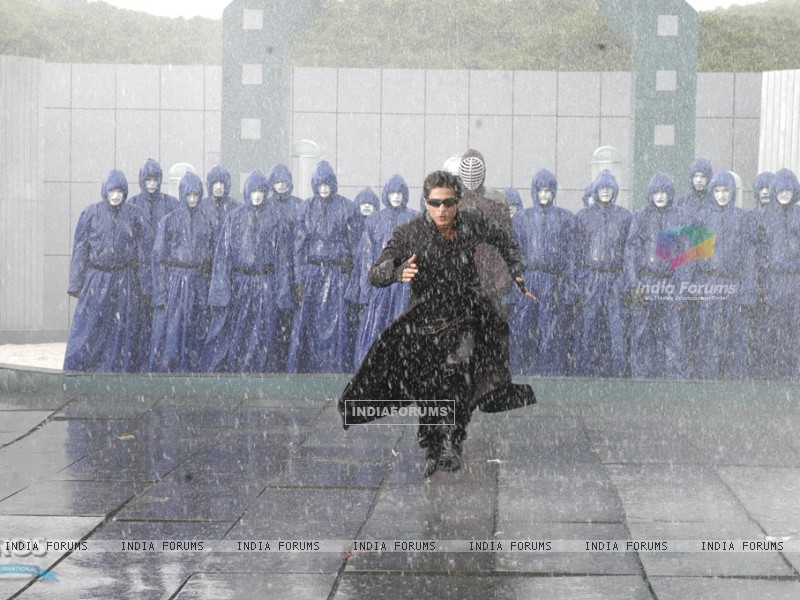
The first thing you learn from Hindi-language films is that the Indians really love American movies. They not only produce their own re-mixed versions of their favorite big Hollywood flicks, they constantly reference dialogue, scenes, and characters that we Americans know and love. It’s easy for people to mistake this tendency as unoriginal, the results being cheap “rip-offs,” but Indian filmmakers are just like the French Nouvelle Vague directors of the 1950s. Their art is significantly reactionary to American cinema.

http://ugc.dhingana.com/uploads/photos/small_650/billu-barber-sharuk-kan-wallpap-3701674404988f67974d642.53797765.jpg
Fig.5 Some of their favorites are The Matrix. And Star Wars. Can you tell?

Everything is a loving homage to what they see in the Hollywood craft, and they most definitely inject their spicy, colorful flavor to the mix, resulting in a hyper-real experience. Bollywood films more often than not deliver a more heightened sensual and emotional experience than Hollywood does. What we call “too much melodrama” in their performances is really just a more stage-inspired “pre-Method” (almost DelSartean) style of acting in which all emotions are exaggerated for greater emotional impact. And boy, does it work.

The highly successful and popular Dhoom franchise is basically Bad Boys plus sexy music videos. Mere Yaar Ki Shaadi Hai is literally My Best Friend’s Wedding, plus sexy music videos. Moulin Rouge, with its high drama, zany comedy, romance and costumes interspersed with pop music and beautiful settings is actually the closest thing to Bollywood any average American has seen. Sorry, but Bend It Like Beckham doesn’t cut it. Slumdog Millionaire is not your standard “masala” movie. The “Jai Ho” item song in Slumdog is the only thing remotely Bollywood in the entire thing. If Bride & Prejudice weren’t in English… then we’d be cookin’.

http://images.sharingcentre.info/Ryoir/Movies/Comedy/dhoom.jpg
Fig.6 I'm crossing my fingers for Dhoom 3

Although more recently, some Bollywood filmmakers (Mani Ratnam in particular, who seems to have a crush on the delicious Abhishek Bachchan) have been experimenting with more realism and grit in their films (Yuva, Rang De Basanti, Sarkar, Guru, Kaminey etc.), the escapist cinema still dominates the industry (Main Hoon Na, Dhoom 2, and the ultimate escapist spectacular Om Shanti Om).

The second thing you learn from Bollywood movies is that religion is everywhere. And it isn’t sublimated into non-denominational themes and motifs, but presented on a golden platter, as simple to pick up as ladoos and samosas. Hearing the many terms for God being dropped all over the place in every genre of film—not just the spiritual ones—was a new experience.

https://blogger.googleusercontent.com/img/b/R29vZ2xl/AVvXsEgyXTCsqeX1lL1k7X3UaNIAyM2WcIw0Jgf5O3DYOLf_fYfzODFCahgMTHPVczBrZtkdqo437mFYtYz5YfwG51xd6CREpSkV5QoLQQimQLB_Ee8WZrX6Jdw795uBcGnf0BQvI53oS-wnSeMa/s400/Yuva07.jpg
Fig.7 Grit and music actually pair well together

to be continued...

Saturday, December 19, 2009

Orthodox Jew Reggae stars and Islamic Rap artists and everything in between

"My heart, which is so full to overflowing, has often been solaced and refreshed by music when sick and weary."
--Martin Luther

Fig. 1 I Always thought clothes were overkill

I loved Ridley Scott’s Kingdom of Heaven from my first viewing at the theatre, and it wasn’t because Orlando Bloom gets shirtless in it (that’s just one reason). With institutions like Liam Neeson and Jeremy Irons involved, as well as an uncredited Edward Norton performance and Ridley’s signature mise-en-scene, it’s a masterfully illustrated story about the folly of pride and the human necessity to embrace all nations as one human family.

Perfectly underpinning this multicultural theme is Harry Gregson-Williams’ rich tapestry of a musical score. It seamlessly weaves Celtic, Mediterranean, and Persian influences into a set piece that is earthly for its mix of instruments, yet otherworldly because it makes the many cultures responsible for the different styles feel as if they were never separated by land or sea. A favorite thread in this score is the angelic echoing vocals of ancient choral hymns. I noticed the simplicity set me at ease whenever I was studying or reading, and I wanted more.

A search for Gregorian chants on iTunes yielded my now favorite group Sequentia, an ensemble dedicated to resurrecting the canticles of medieval Europe. Both male and female voices in predominantly acapella performances transport me to a musical plateau of serenity. Whenever I listen, I can practically smell the incense and feel the warmth of the sun filtering through the stained glass in colored shafts of light. As a bonus treat, Sequentia likes to toss in a few instrumental pieces that showcase the sounds of traditional strings and woodwinds.

There’s something universal and profound surrounding them. Perhaps it’s the sheer grace of God, or just the incomprehensible Latin, but I prefer to think it’s the purity of devotion that imbues them with comprehensive appeal. They were performed to praise a higher existence, not to deride or condemn, but inform listeners of the deeds and love of God.

In Mary Doria Russell’s exquisite novel The Sparrow, a young man working in Arecibo for the SETI program discovers a signal sent through space and time from a star system a few short light years away. He realizes that it’s a song, which indicates intelligent life. Scientists, humanists, and a Jesuit priest are all brought together by that ethereal music, and all of them travel to this new world on the Jesuit organization’s dime. For the Jesuits, as an influential and financially capable organization in the story, the mission is about finding rare resources that can be brought back to fund their missions on earth. For each of the characters, the journey becomes a spiritual test as they attempt to discover the source of the songs on a strange new planet.

Reading the book, I was surprised how moved I was by the description of the SETI discovery and it had me thinking for days about how I’d react to such a significant event. Hearing a song from an alien world filtering down through the stars and vast chasm of space would be a singular spiritual moment for all humankind.

Earth itself has a diversity of music that might overwhelm an off-worlder first hearing it. Even if they only listened to the religious tracks, they’d be surprised at the variety. I certainly was.

Podcasts, movies and documentaries may not be alien sources, but they provided plenty of absorbing listening from perspectives I never knew existed. Here’s a spiritual playlist of some of my favorites:


http://isoas.files.wordpress.com/2008/09/carrie-1.jpg
“There Is A Tree” by Carrie Newcomer
I heard an interview with this Quaker folk singer/songwriter on Interfaith Voices a while back, and was particularly impressed by the mystic quality of this song and her rich, earthy voice. It invokes a sense of the profound in everyday life, as does Carrie’s entire album “Geography of Light.” My other favorite song of hers, “Where You Been,” makes direct reference to many faiths, revealing the universality and playfulness of spirit.

http://www.inkpot.com/classical/people/sequentia2.jpg
“O Quam Mirabilis Est (Antiphona)” by Sequentia

The simplest, most angelic of Sequentia’s tracks. I have no clue what she’s saying, but it doesn’t beg translation. I feel the love, the dedication, the devotion, the joy. It’s beautiful in its musicality, heartbreaking in its purity.

http://zoharmusic.com/drupal/sites/default/files/erran_head.jpg
“Hannukah on Hannukah” by Erran Baron Cohen
I read an article on Tabletmag.org (formerly Nextbook.org) on a newly released album in December 2008 that was created to “change Hanukkah’s reputation.” It’s called “Songs in the Key of Hannukah” and upon hearing it once through, I decided I could listen to it all year long. It’s composed by internationally acclaimed DJ Erran Baron Cohen, who cranks up the irony of his brother’s anti-Semitic characters by injecting a proud and somewhat fundamentalist Jewish flavor to this holiday album. Lighting the shamash and eating sufganiyot has never been so hip.

https://blogger.googleusercontent.com/img/b/R29vZ2xl/AVvXsEjzik_JUEnu3Mwul-Ye5GrlgNFqM5M2QlaS2nVtnDNiKWA45kRB_HXgjhvsOJMxSdmXbN1xwWxy5s3HpASM0ByAcmcdrZow5j2jsEJ4_o5vwL3Zk3YhY5Vka3ibbLp-YEI34H14rcpc5DM/s400/300px-Bibi_snatam_kaur_may06_104.jpg
“Mul Mantra” by Snatam Kaur

Whenever I hear this song, I’m reminded of the long trip between New Orleans and Killeen, Texas with my sister and her husband. I stared out at the endless Texan grazing land and listened to the Sikhwithin podcast, where I first heard Snatam Kaur’s soothing voice. Turns out she’s something of a rockstar in Sikh circles, a California-born woman who performs kirtan devotional music on peace-promoting world tours. The Mul Mantra is the essence of the Guru Granth Sahib, the official Sikh text, and within its few words, contains dense layers of spiritual concepts. Snatam is such a gifted singer that simply hearing her version of the chant without any previous knowledge of Sikh theology, one can sense the depth and emotion and history suffusing it.

http://www.amdoc.org/pressmaterials/newmuslimcool/images/02_newmuslimcool.jpg
“Welcome Home” by Hamza Peréz
Featured in the excellent PBS POV documentary New Muslim Cool, this inspirational rap serves as a primer for leading a righteous life after leaving jail. Informed by Hamza’s own story as a Puerto Rican ex-drug-dealer in the streets of Pittsburg who converted to Islam, this song cuts through to the core of spiritual conversion: to change your life for the better, forever. The film demonstrates the injustices visited upon Hamza’s mosque community as well as the strength of brotherhood and sisterhood they have to endure life’s hardships, and how Islam always guides them toward kindness and standing up for themselves.

http://run4change.files.wordpress.com/2009/08/matisyahu.jpg
“I Will Be Light” by Matisyahu

Matthew Paul Miller, known by his Hebrew name Matisyahu, was influenced through a youth equally defined by Bob Marley and yeshiva, and his music seamlessly sews together reggae-flavored instrumentals and vocals with Hasidic Jewish theological themes. Another Interfaith Voices discovery, this song, with its “dreadlocks to sidelocks” backstory, struck me as a powerful testament to the dynamism of religion and how beautifully it can evolve and inspire each new generation.

http://userserve-ak.last.fm/serve/500/407400/The+Doobie+Brothers.jpg
“Jesus Is Just Alright With Me” by The Doobie Brothers

I just really love this song. It’s very catchy. Its spiritual message doesn’t detract from its pop cred at all. Anyone can listen to it, whether you’re Christian or not, because it’s stripped of dogma. It’s a simple story of finding Jesus as a friend, and no matter that I’m a Buddhist, I can still agree that Jesus is just alright.

https://blogger.googleusercontent.com/img/b/R29vZ2xl/AVvXsEhwsEAeVVhb8qdfuyBp5BR77HvCtB-CrJ7t1nsUZPcaNndg4BT-SYvfOik7y94e9ZPjYf9_i3_82zLSvhLHLM8I19nbvo7DwM84UqmLid2oLb1Nz_FixrNB99T2Hqq9mpvyC6uP04YGcjHU/s400/ar_rahman.jpg
“Pal Pal Hai Bhaarii” by A.R. Rahman

This one is on the soundtack of the excellent hindi film Swades, and it’s from the scene featuring the Ramlila, the traditional play about Lord Ram’s life and adventures. The lyrics are based on the classical storytelling style and as usual, A.R. Rahman’s underlying score defines itself as anything but simple accompaniment. Find the translation of the story on Bollywhat.com and you’ll enjoy the full impact of the lyrics, both dramatic and mystical.

http://www.globalvillageidiot.net/images/2773.jpg
“Sacred Stones” by Sheila Chandra

Oddly enough, I first heard this song on an episode of Queer As Folk, and it was played during a slow-motion sequence meant to give some pause to the usual fast-paced beats that pump through the heart of Babylon, the characters’ nightclub of choice. I noted its singularity among other songs featured in the show and discovered the meditative quality it had. It’s just the kind of song you’d hear playing in the background at a yoga class, but it constitutes more than your standard ambient vaguely South Asian-flavoured white noise. It combines a handful of religious chants in one song to exemplify the tonal, and, incidentally, the spiritual similarities among them. Listen closely.


“Muestro Senyor Elohenu” by Yasmin Levy
Listening to Vox Tablet one day at work, I heard the story of a woman whose father painstakingly preserved thousands of traditional Sephardic songs sung in Ladino—a Hebrew-Spanish language, an Iberian version of Yiddish. Having a Puerto Rican background myself, and a pretty sharp ear for music, I was struck by the instant visceral reaction I had to her voice. In her interview, she described how her feet stood in three worlds—Israel, Arabia, & Spain—and her multicultural influence was so evident in her songs, the unification of which brought me to tears. It still does, every time. Her music, especially this song, is a manifesto for the brotherhood of human life.

http://www.berklee.edu/images/news/124/howard_shore.png
Twilight and Shadow” by Howard Shore
The Lord of the Rings
trilogy is no doubt three of the most spiritual and soul-searching films of any generation, and the music reflects themes as diverse as the races of Middle Earth. I find this track one of the most essential because it distills the complex bittersweet tone of the entire story into a sad but hopeful hymn that you could drop into a list of songs by Sequentia and not know the difference.