Showing posts with label Buddhism. Show all posts

Sunday, March 28, 2010

Dashboard Buddha: Jon Stewart Edition

dashboardbuddha1.jpg picture by monsterunderkilt

"Jesters do oft prove prophets.”
--Regan, King Lear Act V, Scene III

https://blogger.googleusercontent.com/img/b/R29vZ2xl/AVvXsEi_z3wNlcFDfidnpB0UZQGSbkBy6XGN9_iKZoLlbMC36txEyZfkUTguy6cgokk-RNgZGy4KsIeLc9GvtO7pWyDS4qK2ZnF0LEMQUk_zu8DujhyphenhyphenFE554WsDzRQe7gngkNlnjekBRgEu_dJ_m/s400/jon-stewart.jpg
Fig.1 American Buddha?


I read somewhere that to take the Buddhist path requires developing a sense of humor. Humor helps you let go of pride, laughter erodes ego. Obviously, that went a long way with me. Laughter is my drug of choice. I laugh so heartily and consistently every morning and evening watching my favorite shows that my sister’s quaker parrot learned to perfectly imitate my chortles of joy. If I don’t get boisterous at least once a day, I feel stagnant. Heart half-full. If I can laugh all the way to enlightenment, then show me the way.

Jon Stewart has said in a few interviews that a person’s sense of humor only goes as far as their ideology. He explains that sometimes people come up to him and say they love his show and think he’s hysterical except for the time when he made a joke about global warming. Or abortion or foreign policy or last night’s episode of American Idol.

The Buddha says “Attachment causes suffering.” People get offended about things they have a personal affinity for, their attachment to it sucks out all the humor, and they suffer in the form of anger or resentment.

Why do Creationists want to discredit evolution so much? Why do scientists roll their eyes at the idea of intelligent design? Why do Man U fans verbally abuse Chelsea fans at football games? Why did I despise Tina Fey with relish when I heard she dissed Jon Stewart even though it was clearly taken out of context and she doesn’t actually harbor any ill will toward the man in any shape or form except perhaps a bit of envy that he’s so much more iconoclastic and clever and influential than she?

http://analogartsensemble.net/blog/jon_stewart.jpg
Fig.2 Rescue me from ignorance

Each party feels that the Other holds sacred certain ideas that encroach upon beliefs. Our beliefs, which we hold so dear, are very personal and we perceive them as an extension of ourselves. If someone attacks our beliefs, it’s an attack on our own existence.

As self-proclaimed “equal opportunity satirists,” Jon and his Daily Show crew have ripped into everything. Nothing is sacred except the almighty Laugh. He’s the classical court jester: the only person (simply by virtue of being the Fool) allowed to call out the King by poking comedic holes in his actions and policies. The Fool has very little ego and frequently depreciates himself with pratfalls, laughter, and general tomfoolery. He doesn’t care about his reputation.

http://www.freedomsphoenix.com/Uploads/Graphics/173-0804204954-Jon_Stewart_in_2000_and_2005.jpg
Fig.3 Make fun of thyself

A speaker on the Path of the Ekayana podcast once concluded that Buddhism has a joke at its heart. One of the speaker’s teachers—one who always seemed to have a little smirk on his face—said that when you become enlightened (that is, once you don’t care about ego), you get all the jokes. Ultimately, that’s what Buddhism is: getting all the jokes. Everyone should aspire to be the Fool.

That said, everyone should care.

I wasn’t intending to sound cryptic. The best things in Buddhism come in Yoda koans.

The Fool, in fact, does care. He may even care more than anyone else. The trick is to hold that caring like an egg in the grip of the mind. He holds it gently and considers it in its entirety. He holds it long enough to find the flaws and cracks, then remembers that the egg is not an extension of himself. He is not the egg. He is not the anger or worry or disgust. The egg is there to spur the insight to learn or to take action... or make a joke.

http://movingimages.files.wordpress.com/2009/07/jon-stewart-as-saviour.jpg
Fig.4 All in a jester's day's work


The Buddha once told his monk buddies that they should use his teachings as a raft they leave behind as soon as it’s fulfilled its usefulness. You don’t haul a raft out of the river to cross a desert. The raft would be heavy and would just drag behind you and people would question your sanity. Similarly, if the Fool continues to carry the egg, it starts to rot and people tend to avoid him and his odoriferousness.

But the Fool is no fool. He extracts the joke, then promptly tosses the egg away. It smashes against the wall and everyone laughs. We laugh at impermanence because we inherently know that it’s silly to think anything lasts forever. We laugh at our false perception that an egg can survive being thrown at the wall. We laugh at our false perception that our problems will never end.

Laughter is a little piece of enlightenment, and if Jon Stewart teaches us nothing else, it's that fact.

http://www.mediabistro.com/fishbowlny/original/jonstewart_simpsons.jpg
Fig.5 Simpsonified

Sunday, March 14, 2010

Vegan Week

"In the strict scientific sense we all feed on death - even vegetarians."
-Mr. Spock, Star Trek, "Wolf in the Fold"


Fig.1 Have you hugged a chicken today?

One sunny Floridian January Saturday, I drove up to Gainesville to hang out with my friend Casey and meet his boyfriend Joseph for the first time. We checked on the community events for the day and unanimously decided to attend the Hoggetown Medieval Festival. Of course, we had to find a place to eat beforehand, since Joseph is vegan and ren faires are not well known to serve up anything more vegan than giant roasted turkey legs. Luckily, it’s as easy to find a vegan-friendly eatery in a college town as it is to find a coffeehouse in a college town. At the fest, while perusing the numerous vendor tents drinking our mead (vegan!) and scoffing at the bevy of overwrought Scottish accents floating into our ears, theology got injected into the conversation. I have no idea how.

“I consider veganism my religion,” he said.

“Really?”

“Lots of people write in their religion as veganism on the census.”

Veganism is a religion? I’m so there.

Fig.2 They also call loved ones "Agave nectar" instead of "Honey"

Thus, Vegan Week was born. Now, I can do Vegetarian Week standing on my head. Since I started doing Buddhism, I’ve been observing Vesak--the holiday that celebrates the birth, enlightenment, and nirvana of Gautama Buddha--by avoiding meat for the week leading up it. Plus, I renounce meat on full and new moons. And I don’t tend to eat meat all that much anyways.

I’m not addicted to meat, is what I’m saying.

But veganism is a lot of work. I spent a few weeks beforehand researching how vegans sidestep and tip-toe around consuming animal products. Mulling over concepts like incorporating organic alfalfa sprouts, fermented soy tofu, and textured vegetable protein to meals, I paused the way people do when they know they’ve just stepped in dogshit and don’t want to move for fear of hearing that aromatic moist sucking sound you get when you lift your sneaker. But when I picked up my foot and started walking again, collecting recipes that sounded exotic and tasty, I found there was no unpleasant odor clinging to my sole.

Sure, I couldn’t eat anything from the box of Godiva chocolates I had just gotten for Valentine’s Day or sprinkle grated Parmesan cheese on my beloved Italian dishes or dump a little whole milk in my chai tea every morning, but I was going to survive. If it’s good enough for Emily Deschanel (girlcrush!), then it’s good enough for me.

I’m addicted to dairy products, I guess is what I’m saying.


Fig.3 I count broccoli myself

My sister volunteered to take the vegan plunge along with me, so, armed with a list and some recipes, we went to Publix and the Green Bean organic market to gather supplies. We surprised ourselves at how quickly the flip-the-box-to-parse-the-ingredients-list obligation instilled itself into everyday life. I would zero in on the tiny type and wag my finger at any evidence that animals sacrificed their lives or comforts in the making of that product. Whey? Exploits milk cows. Egg whites? Exploits chickens. Honey? Exploits bees. Non-dairy creamer powder? Contains milk derivatives. “Non-dairy” my ass.

We got soy yogurt and soy milk, which we’ve had before and generally enjoy. We made sure to avoid butter and only use olive oil or corn oil for cooking (again, not a big issue). We’re already big fans of nearly every variety of beans (fava, by the way, look and taste like cockroaches, FYI), so we made hummus to use as a sandwich spread for lunches. We also picked up some things we had to learn to prepare, like tofu, bean sprouts, seitan and tempeh.

We had Portobello mushroom Parmesan on spaghetti with crunchy fried tempeh instead of meat crumbles. I made veggie burritos, tofu-cashew curry, and even discovered that vegan brownies taste even more chocolatey than regular ones. Tofutti ice cream, though, is a sad excuse for dessert, sorry to say. And Joseph warned me against “vegan cheese” which not even he would touch. In the end, we survived just fine. It was a challenge, but we came out of it better for doing it, and we learned some new favorite recipes (vegan waffles ROCK) that we’d happily eat outside of Vegan Week.

When our little experiment concluded, I decided that I could never deny my inherent foodie sensibility and significantly limit my intake of the myriad dishes this world has to offer my widely varied palate, but I am apt to expand my meatless options and explore the tastes of vegan cooking. It's always fun to try new recipes, and it's just plain good karma.

Fig.4 Contrary to popular myth, vegan food does not taste like this

One of Joseph’s favorite Simpsons episodes, appropriately enough, is “Lisa the Vegetarian,” in which Lisa realizes that the only difference between the lamb at the petting zoo and the lamb chop for dinner is that one spent two hours in the broiler. Her refusal to dissect an earthworm and inquiries into school lunch policies triggers Principal Skinner into screening an educational video from the Meat Council for the class. Troy McClure gives a little boy a tour of the beef industry, showing off the high-density feedlots and the killing floor of a slaughterhouse, leaving the little boy trembling and emotionally disturbed. When the video is over, the class is treated to a pile of tripe to snack on.

In all my life, I don’t think I’ve ever seen a more masterful evisceration of the beef industry, much less satirized in a wildly popular television show. Read Fast Food Nation or watch Food Inc., and you’ll admit that The Simpsons didn’t exaggerate at all.

At one point in the Meat Council video Lisa is force-fed, Troy McClure displays a chart of the food chain. The image is a drawing of a few dozen wild animals, all with arrows pointing straight at the human drawn in the center, proving that eating meat is totally normal and just part of the natural order of things. And if we're totally honest with ourselves, you have to agree with Mr. Spock on this. Things have to die so we can survive.

This is not propaganda. Humans are omnivores and have evolved to eat both flora and fauna. Our cranial capacity developed as a result of hunting animals, which takes a lot more brain power than picking berries. If our ancestors didn’t eat meat, we wouldn’t be half as smart as we are today. Smart enough, in fact, to make choices about what we cram in our mouths. Vegan Week taught me my own gustatory boundaries and how to explore them, and while I may not be cut out for a completely animal-free diet, I am certainly more aware of how to be educated and judicious about what I consume.

Awareness is what distinguishes an enlightened mind. Christians are working to be aware of Jesus’ love. Muslims practice to be aware of the will of God. Jews believe it’s a duty to be aware of God’s presence. Hindus are occupied with being aware of the divine within each person. Vegans try their best to be aware of our connection to all living things and choose to treat them with the same respect we give to our human race.

That's as good a religion as any.

http://www.animalsuffering.com/resources/photos/images/7-vegan-messages.jpg
Fig.5 I agree

Friday, February 26, 2010

The Buddha is my homeboy

There is no need for temples, no need for complicated philosophies. My brain and my heart are my temples; my philosophy is kindness.
--His Holiness the 14th Dalai Lama


Fig. 1 Dharma punk


There are as many slight variations to the Buddha’s life story and initial enlightenment as there are schools of thought, and technically, since there are as many schools of thought as there are people who perceive them, and all can be considered equally valid, I’ll equally do no justice to all except one: Mine.

Siddartha Gautama was born into a ruling Hindu family in India around the fifth century BCE. His mother Mahamaya had a dream that a white elephant entered her womb through a slit in her right side. Everyone she told about this dream flipped out, saying the kid was either going to be a super awesome king or an enlightened being. While she was pregnant, she was traveling to her parents’ home and gave birth along the way, popping out a perfectly clean baby who started walking only moments later with flowers blooming under each footstep he took while devas(minor gods) sang his praises… until they had to change his first diaper.

Sid grew up with all the lavish comforts of a great prince and was completely sheltered from the outside world right up until his adulthood. His father made sure Sid never saw anyone grow old, get sick or die. Sid grew up, got married, had a kid, and one day decided to cruise around the kingdom outside the palace walls in his chariot, to you know, survey all that would be his one day… other than the curtains. I imagine the historic event of “The Four Sights” unfolded not unlike an episode of Jeeves and Wooster.

http://www.affordablehousinginstitute.org/blogs/us/Jeeves_and_wooster_small.jpg
Fig. 1 Hugh & Stephen are enlightened beings


“Oy, Chandaka,” Sid said, pointing at a man on the street as they drove by. “Who’s that?”

Chandaka, the long-suffering and worldly valet, calmly answered with a polite British accent, “That would be an old man, Sir.”

Sid cringed at the man’s wrinkles and sluggish pace, saying, “Is that normal?”

Chandaka said, “Yes, Sir. All people grow old.”

Next, Sid pointed at a dude face down in the gutter, covered in oozing sores. “Ugh! Who’s that?”

“That’s a sick man, Sir.”

Sid shook his head in disgust. “What’s that all about?”

Chandaka said, “All people get sick from disease, Sir.”

Sid pointed at a corpse on the ground and Chandaka rolled his eyes.

“That’s a dead person, Sir. People tend to die.”

“Ewwww,” Sid said. Then he saw a guy in robes sitting under a tree. “And what about him?”

“That’s an ascetic, Sir. They take a vow of poverty and walk from village to village meditating and learning sacred scripture.”

“Oh, that’s not so bad,” Sid said, scratching his chin. He held up a finger and said, “Maybe I’ll give it a try.”

“Your father won’t be very chuffed, Sir.”

“Forget him!” Sid blurted. “I’m doing it!”

That very night, Sid kissed his sleeping wife and son goodbye and set off into the forest, shedding his royal robes and donning dodgy rags. For six years he wandered around, picking up some flunkies along the way. They all tramped around, eating things no more nutritious than Altoids and enduring the harshest conditions. It was said that Sid once meditated in a circle of fire in the middle of summer, bringing new meaning to the phrase “schvitzing your toochis off.”

Though he was a Hindu who believed in the Hindu pantheon, the enlightened Buddha never really talked about God or gods in general. As far as he was concerned, the Supreme Whatever couldn’t free humans from suffering to save the world(literally), and no compendium of creation stories or polytheistic parables was going to help. Sid made it his mission to find out how to stop suffering if it killed him, and it almost did.

Sid came so close to death from starvation that he realized that he wasn’t a fan of dying, so he resolved to give his body the necessary sustenance it needed for the sake of finding the Truth. He ate one grain of rice and his mendicant buddies said, “Awe, forget you, man. You fell off the wagon. We’re outta here.”

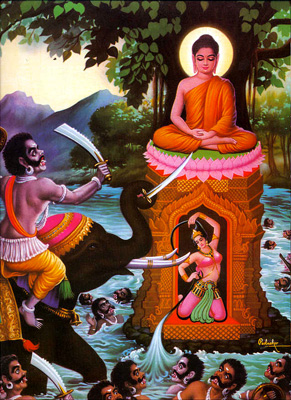
Dissed and abandoned, Sid sat under a tree and meditated for a long time. When he was on the verge of enlightenment, Mara (the deva of wordly temptation) arrived with his armies to try and seduce Sid into staying in samsara, this imperfect human realm of existence.

“Come on, man, you know you wanna make love to my hordes of sexy ladies for all time,” Mara said.

Sid just sat and shook his head. “What’s the point? They’ll all be dead someday.”

“Oh yeah, well my attacking elephants will change your mind!”

Sid just smiled and touched the earth, calling up the earth goddess as witness to his hundreds of past lifetimes filled with good deeds.

Sid smiled and said to the earth, “Hey, baby, show Mara how cool I am.”

The goddess then happily wrung out her long hair, which was soaked with the water of Sid’s meritorious actions, and washed away all Mara’s armies.

Fig. 2 Boo-yah!

Upon his rejection of Mara and further meditation for three more nights, Sid became the bodhisattva formerly known as Siddartha Gautama and awakened as The Buddha—“enlightened one.” The ten thousand world systems shook, he saw all his past lives, he saw everyone else’s and their brothers’ past lives, and he gained the knowledge of the causally conditioned workings of reality. It’s like getting a One Million-Up in Donkey Kong. Plus omniscience.

But there was no Game Over screen. Buddha was enlightened, and he escaped the cycle of re-birth, but he was still dwelling in this world.

So what was next for the Big B?

Spread the word.

The first thing he did was track down his old peeps. They were all sitting around, thinking to themselves, “We’ll show him to eat rice. We’ll just sit here and ignore him as he swaggers by.” As the Buddha approached, they couldn’t resist the plainly apparent aura of love and compassion emanating from him.

“Hey man, what’s up?” one said.

The Buddha held up his hand and said, “My friend, call me the Tathagata (one who has gone onto the path of enlightenment).”

Buddha_at_Deer_Park__jpg_115006965743f4f6d872976 by erindodds10.
Fig. 3 Peeps in the park


He sat down and rapped with them, conducting the “first turning of the Dharma wheel” right there in Deer Park, not far from Varanasi. He told everyone the Four Noble Truths and the Eightfold Path and continued to travel India for a 45-year tour before he merged with the infinite and finally attained nirvana. The Dhammapada, The Buddha’s Greatest Hits, sold like hot chapatiya bread.

No one has to believe this story is true to benefit from the Buddha’s teachings. I love the story, especially the part about the earth being witness to all deeds. It’s the Pagan within me. Yes, it’s a fantastic story full of faith-testing elements of miracles and moral themes, but I’m not going to be punished in some unfathomably scorching piece of real estate for not insisting it’s the absolute truth. I don’t feel an ounce of cosmic guilt for what I believe or don’t believe about dinosaurs or evolution or intelligent design.

The Buddha couldn’t care less what I believe. I could believe in Jesus, Vishnu, Allah, or the Flying Spaghetti Monster and the Buddha would say, “If the sandal fits.” I’m leaning toward the pasta, by the way. It’s the Italian in me. The Gospel of the FSM is very mouth-watering.

Flying Spaghetti Monster by goggle5.
Fig. 4 Yes, I have

The Buddha just hopes I listen and seriously meditate on some stuff, then only use what works. The Dharma teachings are like pennies in the change tray sitting next to the cash register at the Circle-K: take one, leave one, whatever. A penny ain’t worth much until you use it to buy gas. You can quote scriptures till your vocal cords snap, but they only gain worth when they’re applied to your life.

Saturday, January 30, 2010

Dashboard Buddha: Conan O'Brien Edition

dashboardbuddha1.jpg picture by monsterunderkilt

"Starbucks says they are going to start putting religious quotes on cups. The very first one will say,
'Jesus! This cup is expensive!'"
--Conan O'Brien

Fig.1 Tao of Coco

We begin with a koan:

One day, a monk went to the Zen Master as he was sitting in his room one morning. The monk, who had spent several years at the monastery studying under the Zen Master, was finally allowed to speak to him alone. The Master was sitting alone, staring at the floor. The monk assumed he was in a meditative state and bowed, backing away to leave his Master alone.

"Come, sit down," the Zen Master said softly, his eyes never blinking. "What is it you wish to ask?"

The monk, thrilled to have this chance to ask a question of the Master, stepped back into the room and asked, "What can we expect from life?"

The Zen Master still stared at the floor in front of him. The monk walked over, hoping to get the Master's attention by taking a seat on the floor in front of him. The moment he sat down, he felt he had sat upon something. It squished under his bottom. He blushed, surprised.

The Zen Master said, "There is a burrito on the carpet."


Okay, it's not a real Zen koan. But if you've ever read a number of real koans, it's almost indistinguishable in its impenetrable, seemingly useless lesson in Zen technique. And I got the idea from Conan O'Brien.

Fig.2 Keep lookin' up

Conan, of course, has been on many peoples' minds lately. He's been in my heart for close to a decade. I taped him on VHS every night while at college. I named my parakeet after him. I lapse into snorting laughter whenever I watch him. My friend Elissa and I got to visit Studio 6A for a taping of Late Night and got to sit in the front row. So, my deeply emotional reaction (wallowing in grief) to his latest career issues (UNFAIR!) is to be expected. For a good chunk of my life, I hadn't gone more than a few weeks without seeing my Conesie Bone on a regular basis. I had taken it for granted that I'd get my fix for another ten years or so without interruption. I was looking into an abyss bereft of the random, Harvard-trained childishness I'd come to love.

Naturally, I focused my regular meditations on my specific suffering. It's not often that one of my beloved TV gods of choice encounters a crisis, so I was in uncharted waters of concern and helplessness.

After a week of diligent focus during my meditation sessions everyday, a lightbulb popped in my brain. I remembered the Buddha's words:

"All conditioned things are subject to change."

Fig.3 Everything changes... except Conan's crazy hair

One of the most important teachings in all of Buddhism is the truth of impermanence, and that it only sucks if you expect anything different.

"Nobody in life gets exactly what they thought they were going to get," Conan said in his farewell speech.

Buddhist monk and teacher Thich Nhat Hanh once said,"We should not complain about impermanence, because without impermanence, nothing is possible."

If a flower bud remains a bud, it won't show the beauty of the bloom. If the Ancient Egyptian pharaohs were still around, I doubt the pyramids would be half as wonderfully mysterious. If Conan remained at Late Night, we wouldn't know the epic gags and elaborate comedy bits of his reign on The Tonight Show.

Conan's own eccentric comedy style constantly gives us what is least expected, and it's fun, not tragic: a Fed-Ex Pope, a Gun-totin' NASCAR-driving Jesus, a Rocket Raccoon, absurd, cartoonish predictions for the Year 2000, If They Mated pairings of beautiful people that turn out the most hilariously hideous children, State Quarters that commemorate embarrassing events and people. And after all that, the Masturbating Bear jumps out.

Fig.4 Driving the desk straight into my heart

Once upon a time, I clearly remember Conan pointing out a certain foodstuff on his floor. "OH MY GOD! There's a burrito on the carpet!" he exclaimed. I don't recall the context, but I apparently thought it sufficiently hysterical enough to quote it in my LiveJournal several years ago.

That burrito, in its deliciously arbitrary location, is something special. It's strange, but useful and nutritious. But if we are not mindful of it, if we lose our focus and overlook it, either because it's so common or because it's simply unexpected, we'll sit on it.

A monk accidentally sitting on a burrito is funny because we realize the monk's mistake in not paying attention. We laugh because we see ourselves in the monk: distracted, unmindful of surroundings, sitting in an uncomfortable position atop a burrito. Who can say they haven't done something just as silly in their life?

As the last week of Tonight Show episodes aired one by one before my eyes, each conveyed a greater sense of scarcity than the last, until the nacre of rarity coated the last moments in a pearlescent lustre of awesome. Would the January 22nd episode of the Tonight Show With Conan O'Brien have been as precious without its limited edition status?

Impermanence teaches us beauty. If we would just look at every episode in that way, all would be precious. If we could look at everything in life that way, all would be precious.

Conan--who is arguably the one person who most realizes this whole NBC debacle is NOT the end of the world--has taught me to be humble, especially in the face of the unexpected. His self-deprecating manner and clownish antics have endeared him to me in a way no arrogant comic ever could.

The Buddha said:

"To the extent that a fool knows his foolishness, He may be deemed wise."

And the Universe knows how many bajillions of times Conan has said, "I'm an ass."

"Isn't that right, Cactus Chef playing Billy Joel's 'We Didn't Start the Fire' on a flute?"

Sure is, Conan. Sure is.

Fig.5 Celebrate the unexpected

Wednesday, January 6, 2010

When the gods go slumming

"I suppose that's one of the ironies of life-
doing the wrong thing at the right moment.
"

--Charlie Chaplin


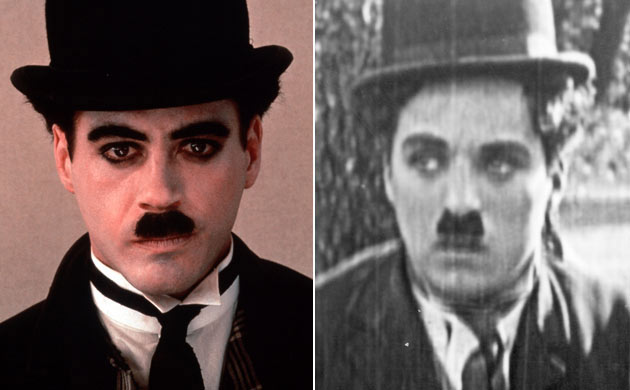
http://static.guim.co.uk/sys-images/Film/Pix/pictures/2009/10/16/1255712523312/Robert-Downey-Jr-and-Char-004.jpg
Fig.1 Robert and Charlie, two of the Universe's best hits

In high school English class, we were once given a special assignment: read up on a VIP in history and write epistles as if we were acquainted with that person. This glorified book report affected my life right then, and the aftershocks still rumble today. At that stage of my impressionable teen years, I was watering the seed of my current passion for classic cinema, so the person I chose was that king of the silent screen, Charlie Chaplin.

Sir Charles is unquestionably a complex and fascinating person, and by many accounts, the most famous person to have ever lived. There was a time when no creed, culture, geography or language was a barrier to his celebrity. Everyone who had ever seen a motion picture knew who he was, and still do. Watching his films and studying his life, one comes to realize that his creative genius was a force of nature, as inherent and apparent in his being as the curl in his hair. I have since read four biographies on the man, viewed every surviving film he ever made (80+), collected photo essays and other books related to his life, and even visited his now historically preserved old studio in the heart of Hollywood, which was nothing less than a religious experience for me.

The day came when I couldn't put off watching Richard Attenborough's biographical film, Chaplin, with Robert Downey Jr. in the titular role. I was never a fan of Ally McBeal, and at the time, the only perception I had in my mind of Robert was of his being in that show which I despised. He was persona non grata by association. I had no faith in the guy, even before he went on his now infamous shame spiral.

Fig.2 Good riddance?

But when I finally saw Chaplin, I was completely baffled by what I saw. Robert had resurrected Charlie, a luminous star who had been crucified by his exile from America in 1953, reborn and re-appreciated in all his glory and flaws through this young, idiosyncratic upstart actor. Robert was essentially Dead To Me, but after seeing him as Chaplin, I moved him to the On Notice board in my mind. There was potential there, and I couldn't ignore that. I was ripe to change my mind entirely... eventually.

Time passed, I read more and watched more, occasionally stumbling upon news of this crazy Robert Downey character's debauched antics. Pooped out on the other side of self-imposed exile, he did a few roles in low-key movies, the best of which, in my opinion, was Kiss Kiss, Bang Bang. I soon found that I was pleasantly surprised to see him involved in David Fincher's Zodiac, and then came along Iron Man, which finally shoved this middle-aged Phoenix out the ashes. Now he's working on a big-budget sequel and doing a wonderful job as Sherlock Holmes, one of my favorite literary characters of all time. He's definitely off the boards and written into the "Gotta love this guy" column now.

http://22.media.tumblr.com/tumblr_ksc2mz9k0c1qzoaqio1_r1_500.jpg
Fig.3 It's a good thing that people (and minds) can change

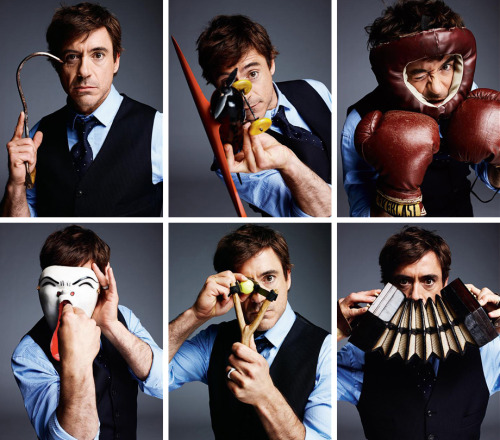
The couple of interviews he gave in Esquire magazine in the past few years contributed to his appeal in my heart. He had a mature and candid attitude toward questions of his stupor-addled years, often describing his thoughts in curiously metaphysical terms. He has an uncanny ability to express his spiritual concepts in metaphors so deceptively simple they float in space, dense as a neutron star in their mystical concision:

"It's something that I struggle with--the embarrassment at being on the side of the coin that no one else had a problem with when you were tails-down."

"I'm in this rarefied air... and it has a shelf life--and then it goes stale."

"There is a bumping up of infrastructure so when the plan makes itself known, it doesn't fall through the cracks--I honestly don't know what the next marching orders are gonna be from the good-guy Cosmos."

"I can't hit my ass with both hands tryin' to figure this mystery. I just know that it winds up coming back to all that old-time religion stuff, except you add science and physics and all of a sudden, faith."

http://faculty.uml.edu/chad_montrie/Scan0004.jpg
Fig.3 Are you a cog or a mechanic to your own machine?

When you come up with gems like those, you've definitely traded the coke for something... else.

One interviewer noted that Robert has a little Buddha on a spring glued to his car's dash. Reading his words, I see that now, Robert is the spring-loaded Buddha on his own dashboard, speaking life's wisdom so jostled by starts and stops. He's especially suited to spouting such circumspection because of his past, and could never have come to those conclusions had he not hit bottom and then crawled back. He probably wouldn't be as good as he is now if he didn't get chewed up a little.

We all love an underdog, but why is it some people who seem to have all the brains or the talent or the charisma seem prone toward personal catastrophe?

Charlie once said, "The human race I prefer to think of as an underworld of gods. When the gods go slumming they visit the earth. You see, my respect for the human race is not one hundred percent."

In Buddhism, there are dozens of levels of existence: heavens, hells, animal realms, human, god, bacterial, hungry ghosts, etc. Karma determines where a soul is incarnated, and oftentimes, one makes it to the highest god realm. This realm is just short of nirvana, so even the gods are still subject to karma. When all the good karma that got them into the god realm burns off, they sometimes get dumped back into a human realm. The gods go slumming, and they are so acclimated to the creature comforts of the higher realms that they freak out a little when they come back to the suffering of Earth. They're higher-functioning humans than most, but they get frustrated in this lifetime.

Charlie, with all his ego, recognized his own fall from the god realm into this one. He was at once respected for his art and maligned for his controversial personal problems.

It's no mystery why Robert portrayed Charlie so perfectly in the biopic--they're from the same stock. Both great artists in their own manner, so equally inspired and troubled by superhuman foibles, and redemption is a significant part of their stories. The same might be said for Michael Jackson or Tiger Woods--supreme talents with issues, redemption on the horizon.

When the gods go slumming, the horizon is theirs for the taking. They long to go back to it somehow; their home is that place where Heaven meets Earth. How they walk off into it is up to them.

http://streethawker.files.wordpress.com/2009/05/chaplin-charlie-modern-times_02-jt1.jpg
Fig.4 Even a poor Tramp is entitled to some happiness

Tuesday, December 29, 2009

Dashboard Buddha: Doctor Who Edition

dashboardbuddha1.jpg picture by monsterunderkilt

"Mankind doesn't need warfare and bloodshed to prove itself. Everyday life can provide honour and valour. Let's hope that from now on this country can find its heroes in smaller places. In the most ordinary of deeds."
--The Doctor


Fig. 1 The Doctor is most definitely IN

In the series three finale of the new Doctor Who, the “Master”—a powerful Time Lord gone completely mad—seizes control of the planet Earth and rules with no mercy for an entire year. During that time, the Doctor is imprisoned, but he tells his trustworthy companion, Martha, to roam the world in order to develop a weapon against the Master: a special injection gun that will kill him instantly. The Master finds her and destroys the gun, but Martha is amused that the Master would think the gun was their entire plan.

“As if I would ask her to kill?” the Doctor says from his cage, displaying his usual reluctance to take life, even in such an extreme situation. Killing was the Master’s way of doing things, but that’s not the Doctor’s style.

Turns out the real plan was to the spread the word of the Doctor’s powers in order to get everyone on Earth to call out his name at a certain moment—a prayer of hope, if you will—which magically breaks the Doctor’s bonds and renders the Master powerless. Up until that moment, for the entire year, the Doctor had said time and time again that he had one thing to say to the Master. The Master knows what it is, and he takes it as a threat.

“I forgive you,” the Doctor says, embracing the fearful Master as a friend.

Despite all the Master had done to hurt and kill humans, the Doctor had no intention of harming him. The Master, after all, was the only other Time Lord in the entire universe, and the lonely Doctor didn’t wish to lower himself to a level of hatred and malice that would cut his population in half.

After the Doctor reverses time and the world goes back to what it was before the year of tyranny, Martha, upon looking out at all the people in London, says, “A time was, every single one of these people knew your name, now they’ve all forgotten you.”

“Good,” the Doctor says without hesitation, as he is happy to be perpetually uncredited for his part in saving lives.

Fig. 2 Make nice with your enemies

That Doctor Who episode reminded me of the tale of Ungali Maal and the Buddha. Ungali Maal was a fearsome man who wanted to sacrifice a thousand people to a goddess. He got his name, which in Sanskrit means “finger necklace” because he would take his victims’ fingers and string them together and wear them around his neck. After killing hundreds of people, Ungali Maal encountered the Buddha in a jungle and wanted to kill him as well.

The Buddha was fearless and said, “Take a leaf from that tree there, buddy.” Ungali Maal humored him and plucked a leaf from the tree. The Buddha then said, “Now put it back on the tree.”

Ungali Maal said, “Pfft, that’s impossible. You can’t put a leaf back once you’ve taken it.”

The Buddha said, “Then if you can’t put it back on, you shouldn’t pluck it off in the first place, my friend.”

Ungali Maal realized the real meaning of the Buddha’s lesson and immediately bowed down to him, the Buddha forgave him, and Ungali Maal the murderer went on to become a saint, one of the Buddha’s most devoted followers. The Buddha would never take credit for Ungali Maal’s transformation because he didn’t force him to be good, Ungali Maal himself made the decision to be good.


Practicing forgiveness and modesty is a very Buddha thing to do. It’s a very Muhammad thing to do. It’s a very Jesus thing to do. What if we treated all people like they’re the last of our kind?


http://static.tvguide.com/MediaBin/Galleries/Shows/A_F/Di_Dp/doctorWho/2006_additions/doctor-who-tennant33.jpg
Fig. 3 A little sonic screwdriver for the soul

Thursday, December 3, 2009

Head to the ground

"The earth has been made for me [and for my Ummah] as a masjid [place for worship] and a pureness ; therefore, anyone of my Ummah can pray whenever the time of Prayer is due."
--Prophet Muhammad


Fig. 1 A two-year-old can understand this. Someone fetch me a two-year-old!

Listening to a Speaking of Faith podcast from a few years ago, I was struck today by Ingrid Mattson’s description of her first prostration experience. This particular episode is an interview with Ingrid regarding her conversion to Islam and subsequent appointment as the first woman president of ISNA, the Islamic Society of North America.

Ingrid tells the story of being in France during her first exposure to Senegalese Muslim devotees who became her friends. One day, they invited her to pray with them and she said she didn’t know how. They said that she could just follow along with what they were doing, so she obliged. Islamic prayer, the du'a, involves many steps, including several body positions and prescribed chants and Ingrid felt extremely awkward trying to keep up.

Fig. 2 I'm pretty sure it's not quite this complicated

But once she had her forehead to the ground, taking pause in that position, she felt closer to the earth, closer to God, and in the intimacy of the moment in which she could not be distracted simply because her eyes are staring at the floor, she felt prayer as a full body experience for the first time. When I heard her say that, I remembered that I had the exact same feelings doing my first Buddhist prostration.

I don’t know about y’all, but the last time I had my forehead to the ground was last night, after dinner. My pre-yoga ritual consists of what may be called a standard Buddhist chant:

I take refuge in the Buddha.

I take refuge in the Dharma.

I take refuge in the Sangha.

I follow this up with candle-lighting and some prostrations of my own, borrowed from the Tibetans. I hold my palms together in a specific mudra (hand formation) and touch the top of my head, my forehead, my heart, and then bend down for a full-body prostration on the ground, touching my forehead to the carpet. I do this three times, each time reciting the above mantra.

Fig. 3 Olympic Cross-country prostration

When I did this for the first time, I was in the privacy of my bedroom, with nothing to distract me and no one to see me make this new step toward adopting a cultural tchotchke my new faith. It felt incredibly strange and awkward. As a not-so-churchy person to start with, when I saw movies and documentaries showing Buddhists doing this pretty obvious, involved, anti-subtle prayer ritual, I was confused. I had to keep in mind that it was a Tibetan-style prostration, one full of meaning and metaphor and even superstitious history, but it was beautiful and I wanted in.

I wanted to “create sacred space” and learn to respect it by bookending my meditations and yoga practices with a small ritual.

But the prostrations were awkward for more than one reason, i.e. I had no clue what I was doing because I had never done them before. It was strange because bowing and touching the floor, in Western society, is associated with subservience and is way too self-deprecating an act for a middle-class protestant nation that worked very hard to escape class-obsessed systems and aristocratic societal structure.

For Eastern societies, these acts are a sign of profound respect toward someone or something and in no way demeans the person doing them. It is humbling, but it’s a willful humility I adopt whenever expressing my respect for my teacher, The Buddha. I bow to him, not as a worshipper, but as a student, and in the process, I also bow to nature and the Universe, connecting myself to a stable ground beneath me through a gentle touch that always touches me back.

I definitely fulfill my quota of hours with my head in the clouds (and especially in outer space due to my love of astronomy), so it's common sense to balance it out by literally touching it down to the ground everyday.

Saturday, November 28, 2009

How to win the cosmic war on Christmas

"... the only way to win a cosmic war is to refuse to fight in one."
--Reza Aslan

http://konceptsbykaryn.com/wp-content/themes/blank2L/images/santa-alien-ornament.jpg
Fig. 1 Season's Greetings, Earthlings


At Thanksgiving dinner this year, my uncle made a curious observation about my aunt's shopping behavior. She, my little cousin and my grandma have made it a tradition to wake up at 3 am every Black Friday and rush off to a major mall to take advantage of the bajillions of holiday doorbuster deals that surface every year right after Thanksgiving. I thought it was a harmless tradition, giving those three some time together doing what a large percentage of folks do this time of year. Nothing special. But my uncle mentioned that my aunt would buy one or two of that year's "hot" and "hard-to-find" item for the sole purpose of bragging rights, then return it a few days later. She did it to prove that she had the shopping skillz to grab a certain DVD or toy before anyone else, then get a refund after the stampede of shoppers was over.

I said to my aunt, "You know there are desperate people who would probably commit a hate crime against you for doing that."

She said, "I know!" and laughed.

Fig. 2 The Cathedral of Shopping: The Mall of America

Earlier, while waiting for the turkey to be sliced, I was in my cousin's room, assisting her with decorating some black t-shirts with fabric paint and glitter. She had three of them, each with their names on the back and "Black Friday 09" plastered across the front. They claimed that they all wore the same thing so it was easier for them to find each other if they got lost in the "running of the crazed consumers." I thought it was fairly practical at the time, but in light of my uncle's comments, I saw this Black Friday activity for what it truly was: a sport. They had uniforms and a healthy sense of competition. Well, maybe not so healthy. Shopping for Christmas has become a full-contact sport requiring a certain level of cynicism and defiance with a full-throttle ego boost that accompanies success.

I love my aunt, cousins and grandma dearly, and I'm certainly not judging them for commiting a mild offense against other early bird wacko types who place way too much value on obtaining half a dozen Zhu Zhu robotic hamsters, but seriously... is this the real problem with Christmas?

Fig. 3 Worship the almighty Flying Christmas Presents

The mainstream media outlets (and Stephen Colbert) have been reporting on the so-called "War on Christmas" for years. They focus mainly on Wal-Mart greeters' usage of "Happy Holidays" over "Merry Christmas" and overly PC people shoe-horning in holiday wishes that include Chanukah, Kwanzaa, Eid, Festivus, etc. into their holiday office parties and gift-giving activites. Because God forbid we respect all the less-than-overcommercialized sacred festivals of other religious traditions celebrated by citizens of this country. This hyped-up paranoia about Christmas supposedly getting usurped by other holidays is patently absurd, of course, since the real threat to Christmas is the deep-seated materialism that surrounds it. The true meaning of Christmas, in my opinion, is not at war with outside aggresors, but from within.

Yes, this argument has been raised as well, and by the very same people who bring up the anti-PC argument. I only invoke the argument because as a Buddhist convert, I've had to recently reinterpret my reasons for my continued observance of many holidays, as well as summon a mission statement regarding my observance of Hanukkah, Diwali, Passover, Samhain, Holi, Yom Kippur, etc. in an effort to further my multipraying quest.

Fig. 4 Jon can't believe dreidels can't compete with Santa Claus

I could have woken up one day and played the "I'm not Christian" card and declared that I didn't have to participate in anything that wasn't related to my new spiritual path. Hey, it would save me a shitload of cash and headaches every year, wouldn't it? I could have sat back and amused myself by anthropoligically analyzing all the fun out of these gauntlets people perrenially embark upon in order to please their money gods. It would have been too easy to just excise myself from the holiday fray and meditate on the futility of materialism.

The year I converted myself, that first year I had to experience Christmas without the churchgoing obligations or the latent guilt of not really believing the nativity story and how to reconcile that with the obsession over Santa Claus and elves and fruitcake and inflatable lawn decorations and credit card debt, I was free. I was free to understand.

I understood for the first time how other religions effected Christmas. And despite what I've heard from a particular cynic who shall remain anonymous, it's not a bad thing that Christianity has been touched by religions that came before it. Jesus wasn't born in December, but more likely around the time Jews celebrate Sukkot in the fall. Or perhaps in the spring. Christians today celebrate in winter because that's when pagans celebrate Yule and Saturnalia and other winter festivals, and Emperor Constantine cleverly moved the date to make it easier for pagan converts such as himself. Santa Claus is derived from the Turkish Saint Nicholas and the popular back story of his life is drawn from Germanic folk traditions. Dragging an evergreen tree into your house and lighting it up to remind you that life persists through the bitter winter? How totally pagan of you!

Screenshot2009-11-28at124259PM.png picture by monsterunderkilt
Fig. 5 Jesus wishes he were born on Christmas

Christmas is not "diluted" by these non-Christian influences, but enhanced. It has been enriched by the numerous converts through its history, converts who brought their own flavors to the big melting pot of Christmas. Gift-giving, baking, decorating, visiting with family, and parties have basically become secular activities in December, and this captures the distinctly American influence on Christmas: sharing it with everyone, no matter the race or creed. With this in mind, it's difficult to put stock in the paranoia, the superficial culture war borne out of fear and ethnocentricism. The problem the warriors for Christmas have is with themselves, and unable to appreciate or recognize the beauty of the Christmas collage, they lapse into self-loathing without even knowing it.

Fig. 6 Who's to say the Festivus Pole doesn't enhance Christmas?

I now fully understand what Christmastime means to me: family gatherings, seeing far-flung friends, creating homemade gifts, lighting my menorah, baking Martha Stewart cookies with my sister, watching holiday classics like National Lampoon's Christmas Vacation, Lord of the Rings, and Doctor Zhivago, playing A Colbert Christmas music on an endless loop, enjoying the laughably mild winters of Florida, but still freezing my ass off to see the Geminid meteor shower on a clear cold night.

If Christmas to you means a false sense of "purity" over a rich medley, or if it means casting aside all other holidays in an effort to "preserve" a homogeneous past that never existed, then you're participating in a cosmic war that cannot be won by anyone involved.

I choose not to participate in the cosmic war. I choose to participate in Christmas. It's the more Buddhist thing to do. It's the more American thing to do. It's the human thing to do.

Fig. 7 Totally Kosher.

Saturday, November 21, 2009

Dashboard Buddha: Dune Edition


dashboardbuddha1.jpg picture by monsterunderkilt


The universality factor is not one limited to Buddhism. Followers of every religion see aspects or images of their faith in everyday situations, culture, literature, and sometimes even tortillas and cinnamon buns. These “sightings” often end up telling us more about ourselves than about the religion, i.e. seeing the beauty of a blooming flower as evidence of a supreme being’s love of beauty or that we truly bask in the wonder that God would take time out of his busy daily schedule to manipulate the heating elements in toasters to create vaguely Jesus-shaped burn marks on bread.

But what is most telling about such visions is that we want to believe. We want to believe that the words of our gospels, hymns, pujas, mantras, and prayers apply to our lives in a fundamental and thinly veiled manner. This is natural and to be expected if we are ever going to push ourselves through toward heaven or enlightenment. Unfortunately, this expectation has to potential to limit our spiritual vision. If we only look for what is obvious as a sign that we are on the right track, we miss out on the infinite subtleties of the Universe. An outsider may not understand the spiritual significance of a Native American peyote ritual or a sweat house, simply because Jesus didn’t talk about it. Or someone may not understand the simple antiquated existence of Mennonites because they live in a metropolis and can’t imagine not having a Facebook account.

In my Dashboard Buddha entries, I will chronicle my attempts to lay the template of my beliefs over commonplace things. It could be any number of sci-fi fandoms, a weekend activity, a movie, a book, a TV show, or a single act of a person that struck me as an enlightened thing to do. I’ll make a concerted effort to turn my spiritual gaze toward the ubiquitous and the unintentionally profound. As George Clooney once said in O Brother, Where Art Thou?, I will “see the lilies of the goddamned field.”

I christen this column with a piece about that most famously misunderstood and deeply geeky of sci-fi adventures: Dune.

I must not fear.

Fear is the mind-killer.

Fear is the little-death that brings total obliteration.

I will face my fear.

I will permit it to pass over me and through me.

And when it has gone past I will turn the inner eye to see its path.
Where the fear has gone there will be nothing.

Only I will remain.
--Bene Gesserit Litany Against Fear, "Dune," Frank Herbert


Lego-Dune
Fig. 1 You know you've made it when you're immortalized in Lego

I’m probably one of the few people who saw the original 1984 David Lynch film version of Dune and was positively mesmerized instead of utterly dismayed. I only saw it because I had been watching Twin Peaks re-runs and had a crush on Kyle MacLachlan and I did what any self-respecting teenage girl does when she has an actor infatuation: I watched everything I could find no matter the known quality or lack thereof. What resulted was affection more powerful than that between a girl and her Hollywood boyfriend. The world of Dune had been unleashed upon my impressionable, youthful sci-fi nerd brain and I was dutifully impressed.

When my dad told me I should read the book I was wholly gobsmacked. “There’s a book?! I must read this book!”

Soon after I started reading Dune, I had the privilege to be retroactively disappointed in David Lynch’s movie. This is the complete opposite experience for most people who love Dune. I believe my example proves more the undeniable genius of Frank Herbert than any backwardness on my part.

Dune, which is richly saturated in all manner of religious allusions, has become an exceptionally abundant goldmine for me. The flakes of Buddhism are shiny and plain to see.

At the beginning of the novel, Paul Atreides, the son of the Duke of Caladan, must undergo a special test. It’s a test that will help determine if he is the Kwisatz Haderach—a prophesied messiah in the “Duniverse” who is said to have the power to bridge time and space and inherit the memories of all his ancestors. The test, which involves placing your hand into a black box and feeling it burn with incredible unbearable pain, is designed to test one’s ability to see through fear, and therefore determine your human-ness (as opposed to “a machine created in the likeness of the human mind”—the ultimate sin). The box itself is nothing more than a box, but through “nerve induction,” you are made to believe that your hand is burning up inside.

http://www.goats.com/store/images/kwisatz_preview.png
Fig. 2 Walk without rhythm, you won't attract the Worm

During the test, Paul repeats the Litany Against Fear over and over in his mind and passes the test, never jerking his hand out of the box because he realizes that his fear is unfounded. He is the first male in history to pass this test, which makes the Bene Gesserit suspect that he is the Kwisatz Haderach.

The fear Paul experiences is just an altered perception of reality. Buddhism suggests that all of reality is perception. The key concept of the Diamond Sutra—so-called because it cuts through illusion as sharply as a diamond—is that nothing is what it seems.

Fig. 3 The Diamond Sutra is the Buddha's best friend

The Diamond Sutra invokes the example of a rose. What is a “rose?” It’s made up of thorns, petals, a stem, water, chlorophyll, some perfume. But each of these things alone is not a “rose.” That object we call “rose” is actually an amalgam of parts that constitute a “rose.” Just as we are not fully ourselves without our body parts and a soul or an ego and the people who surround us and call us by our name, a “person” is a combination of things. Nothing, except perhaps subatomic particles—and we can’t even be sure of that—is independent of other things.

We meditate upon this and discover a simple, yet weighty philosophical equation: a “rose” is a “rose” because it is not a “rose.” That’s Buddhist math for you.

http://a69.g.akamai.net/n/69/10688/v1/img5.allocine.fr/acmedia/medias/nmedia/18/35/54/37/18450511.jpg

Fig. 4 Kyle MacLachlan IS the Messiah because he is NOT the messiah... especially if he can't beat up Sting

A through-line theme of Dune is that the mahdi “Messiah” or “God-Emperor” involved is not simply a messiah or a god-emperor. Frank Herbert writes of “a world being the sum of many things.” The prescience and “other memory” of all the messiah’s past ancestors makes the messiah everything and everyone, dependent on everything and everyone. Muad’dib is Muad’dib because he is not Muad’Dib.

Muad’Dib, being the wise and prophetic man he is, would have agreed with Buddha implicitly: “There exists no separation between gods and men, one blends softly casual into the other.”

The preceding essay is in no way exhaustive of Dune’s spiritual ore. I promise it will surface again and again in the future, like a tea leaf stirring around and around, up and down in a hot teapot. Mmm spice tea...

Long Live the Flavours of Muad'dib by phronetic.
Fig. 4 Dune in-joke du jour

Sunday, November 15, 2009

Jesus Is Just Alright With Me

“And though I am a committed Christian, I believe that everyone has the right to their own religion, be you Hindu, Jewish or Muslim. I believe there are infinite paths to accepting Jesus Christ as your personal savior.” 
--Stephen Colbert


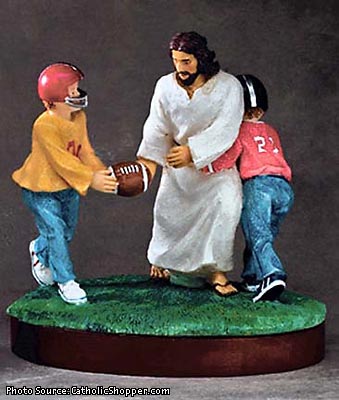
http://www.darbois.net/articles/photo_1_sp_jesus-football.jpg
Fig. 1 Jesus: the best first round draft pick for running back

Somehow, in one of my random best-friends-only college era gatherings, someone came up with the placeholder moniker “Jebus Crisp” for use as a mild curse, and it stuck pretty permanently in my mind (this is me not taking the Lord’s name in vain). Oddly enough, several years after that memorable occasion, Homer Simpson yelled “I can’t be a missionary! I don’t believe in Jebus!” Proof positive of that collective human mind field Deepak Chopra’s so hot about.

Sometime after my Buddhist revelation, someone once asked me what I think about Jesus.

"Jesus is cool," I thought. "He's wise and good and genuine. I have no beef with Jesus."

I also know I prefer Willem Dafoe Jesus over James Caviezel Jesus. Or "Imma only make a cameo in Ben Hur" Jesus. That's just lazy.

http://dannymiller.typepad.com/blog/images/willemdafoe.jpg
Fig. 2 The Last Temptation of Scorsese

I love Jesus more now than I ever did as a Christian. Maybe that’s my fault, since I know plenty of people can love Jesus and be Christians at the same time. It’s probably meant to be that way, actually. Some people’s boats float better in different liquids.

Still, I’m all for listening to hippie types. He told off the authorities and chilled out with prostitutes and gave outdoor “God is love” sit-ins on grassy hills. Jesus had the long hair, threadbare clothes, was always wearing Birkenstocks and bumming food off of people while fighting with his father. “Dad, I’m gonna die for these people whether you like it or not!” I believe is what he said while he was dragging the cross through those thirteen stations.

Jesus is the ultimate treehugger. Don’t tell Greenpeace about that one time he cursed a fig tree for not bearing fruit and it shriveled into a barren twig.

“I curse you for not bearing me any fruit!” *poof*

His apostles all trade looks, then one asks, “Dude, what did you do that for?”

*cough* “Well, umm… Anything is possible when you believe in God!”


http://www.reverendfun.com/add_toon_info.php?date=20020513&language=en
Fig. 3 Jesus caused the first Fig Newton shortage in history

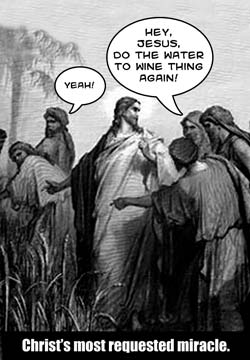
Even Buddhists squash ants in forgetful moments, so no one is about to fault the Savior of a third of this planet’s population for having a black thumb. The rest of his hand could heal water of its non-wineness, which, understandably got him invited to a lot of parties.

Fast forward a couple thousand years and he’s still on the top of the A-list, but he’s one of those people who has so many friends from so many walks of life that some of them can’t be in the same denomination together.

This makes for sometimes awkward housewarming shindigs. The Baptists roll their eyes at the Catholics for paying too much attention to the Virgin Mary. Fundamentalists sneer at the Episcopalians for bringing that gay guy into the clergy. Methodists stare at the token Jehovah’s Witness who stands in a corner and tells himself that everyone else is just jealous because he doesn’t have to go into debt every December buying Christmas presents. But even the Witness is surprised when a Mormon shows up and most everybody is pretty sure no one sent him an invite.

No matter what the party, some people tend to forget that Jesus sends everyone an invite.

Fig. 4 Jesus loves viniculture

In Acts 10:34-35, Peter says “I see very clearly that the Jews are not God’s only favorites! In every nation he has those who worship him and do good deeds and are acceptable to him.” I also recall some stuff about Jesus having sheep that are not of his fold, and that they will hear his voice (John 10:14-16.) Jesus knew God spoke to people outside the Euphrates River Valley. It wouldn’t make sense not to somehow clue in the rest of your creation, after all. Talk about lazy.

This is the Jesus I love. The Jesus who informs a Christianity of the red letters, not the accusatory finger. The Jesus of the healing hand, not the fist and the sword. Buddy Jesus from Kevin Smith’s Dogma. The smiling, thumbs-up Jesus who walks and talks with you.

http://blog.osministry.com/wp-content/uploads/2007/05/lol_buddy_jesus.jpg
Fig. 5 Jesus loves you, man!

Jesus, like all spiritual figures, is a Rorschach test. In my eyes, the inkblot represents a man of revolutionary compassion who reaches out to the impoverished, condemned and criminalized people of the world, then lifts them up with all the strength they already possessed within themselves. The strength of God. The strength of the Universe. The strength of human kind.